
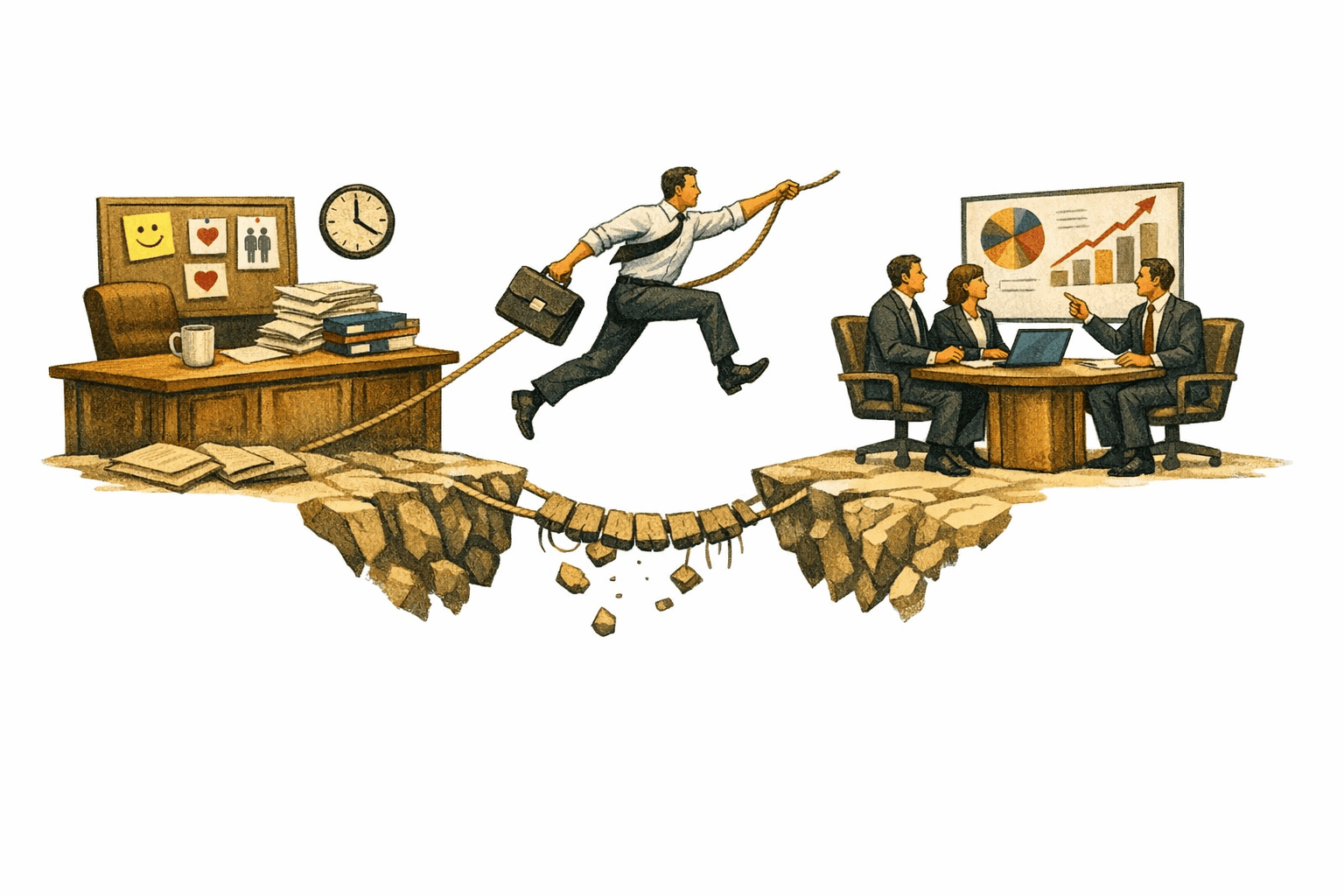
In a world where workplace expectations shift faster than corporate structures can adapt, organizations face a growing gap between what people need and how they operate. To bridge this gap, we must sometimes challenge what seems obvious in the mainstream. And one of the most surprising examples of how easily shared beliefs can be constructed was the story of Listenbourg.
by Robert Dobay
Listenbourg, the fictional European country invented as a joke on social media, quickly evolved into a spectacular demonstration of collective intentionality. Within hours, thousands of people began adding:
- Maps, flag
- Historical narratives
- Government structures
- Cultural artifacts
- Transportation networks
All for a country that had never existed.
This wasn’t deception. It was a live experiment in how human beings can create shared reality simply by deciding together that it is real. Social and neuroscience research points to this as a basic property of human cognition: when enough people observe, believe, or participate in something, they co‑create a new truth.
And sometimes, like Listenbourg, they’re built on assumptions no one has ever questioned.
Opinions must not replace data: planes don’t fly on feelings
Yet in many boardrooms, HR discussions are still driven by subjective judgment, personal bias, or anecdotal stories. For example, when talent — your company’s most valuable, expensive, and scarce asset — is managed by gut feelings, the organization is flying blind.
In too many companies, HR has not been designed or empowered to operate like a data-driven strategic function. Instead, it is still treated as:
- An administrative service
- A compliance enforcer
- A “soft skills” department
- A firefighter for people issues
Meanwhile, the departments that do get board seats, like finance, sales, operations speak the language of data:
- Forecasts
- Run rates
- Margins
- Productivity
- Pipeline health
HR must evolve into the people analytics function, capable of providing the same level of evidence-based intelligence on:
- Engagement
- Capability development
- Leadership effectiveness
- Cultural frictions
- Internal mobility
- Attrition predictability
- Retention economics
If HR could quantify people as precisely as finance quantifies money, HR would be indispensable in the boardroom.
Act2Manage Application
An interactive, gamified, practice-oriented leadership development application that provides immediate help and enables follow-up to the most common dilemmas.
Challenging the mainstream
If we want better business contribution from HR, we must challenge three assumptions:
1. That culture is intangible
It can be measured.It must be measured.And it should drive strategy, not follow it.
2. That HR is soft
People decisions are the hardest, most expensive, and most impactful decisions in business.They need instrumentation, not intuition.
3. That HR is the “owner” of people problems
Most people problems are leadership problems or system problems.
HR must architect systems that make leaders — and the organization — accountable for culture, performance, and engagement.
- Build HR into a data-driven strategic engine
- Design workplaces to better support "Quality of Life"
- Replace opinions with instrumentation
- Build systems that reward experimentation, not conformity
If we do this, innovation will return - not as a fortunate incident, but as an organizational habit.